
Governed, scalable EEG operations across your sites.

Standardize EEG intake and operations across facilities while each site keeps its local configuration, with the governance, security review, and interface readiness your system requires.

Do not include patient information in demo requests. Demo environments use synthetic data only.

The system-level challenge

Rolling one EEG workflow across facilities fails in the same five places. Each is a governance problem before it is a software problem.

Where this sits

Human-reviewed. Built specifically for EEG. Designed to complement your EHR and EEG acquisition system.

  1. Every site runs EEG intake a little differentlyDifferent columns, different dropdowns, different local habits. A single rigid template gets rejected on arrival.
  2. Governance and template changes are hard to control at scaleOne edit in the wrong place reaches everyone using that workspace, and afterward nobody can say who changed what.
  3. Interfaces have to route through your interface engine, on your termsIntegration is an interface project with its own testing and acceptance, not a checkbox on a purchase order.
  4. Security review and enterprise permissions come before any rolloutAccess model, tenant boundaries, audit posture, and the PHI position all get reviewed before the first site turns anything on.
  5. Leadership needs cross-site visibility without flattening local workflowsA network number nobody can trace back to a facility is worse than no number at all.

One governed standard, configured site by site.

Five capabilities carry a multi-site rollout. Each one is enforced in the product, not promised in a deployment plan.

01

Governed templates with draft-and-publish change control and version history

Edit a draft, preview exactly what publishing would change, then publish deliberately with a typed change summary.

02

Entitlement-controlled capabilities per workspace

Capabilities resolve from the contracted package and are enforced on the server, not merely hidden in the interface.

03

Configuration portability for multi-site rollout

Export a template’s configuration and import it at the next site. Configuration only: no rows, no cells, no tokens.

04

HL7 v2 / FHIR R4 interface readiness, with each production connection separately scoped, tested, and accepted with your interface team

Secure document upload, email, and configured fax intake work without an interface project, so a facility can begin before the interface lands.

05

Cross-site rollup with per-site drill-down, and complete audit history

Network totals are the sum of the per-site rows, read under your own memberships, so the two views reconcile.

Template changes are events, not surprises.

When the draft workflow is required, the live template is frozen and every change travels the same four steps.

Step 01

Draft

Edit a copy of the live template. The Intake Tracker your staff are working in does not move while you work.

  • Locked system columns stay protected
  • Resume the draft later, or discard it entirely
Step 02

Preview

See precisely what publishing would add, rename, or retire, before anything reaches the department.

  • Staged changes listed line by line
  • A stale draft is refused rather than overwriting newer work
Step 03

Publish

One deliberate action, recorded with a typed change summary and the person who made it.

  • The published version is retained, not overwritten
  • Orders keep the template version they were captured under
Step 04

History and restore

Read what changed between versions, and bring a prior version back as a new version.

  • Who published it, when, and what moved
  • Restoring adds a version rather than rewriting the record

The draft workflow can be required per workspace, and it switches on when a workspace moves to a customer contract.

See the network. Then see the site.

The rollup answers the system question. Each number leads back to the facility and the records behind it.
  • Volume, review queue, reader backlog, unbilled work, and overdue devices, per facility and in total
  • Totals are the sum of the per-site rows, from the same queries at the same instant
  • A site whose data could not be read is marked unavailable and left out of totals, never counted as zero
  • Drill into a facility and land in its own queue, with the workspace switch recorded in that facility’s audit history
  • Reporting period, timezone, and the method behind each figure are stated on the page
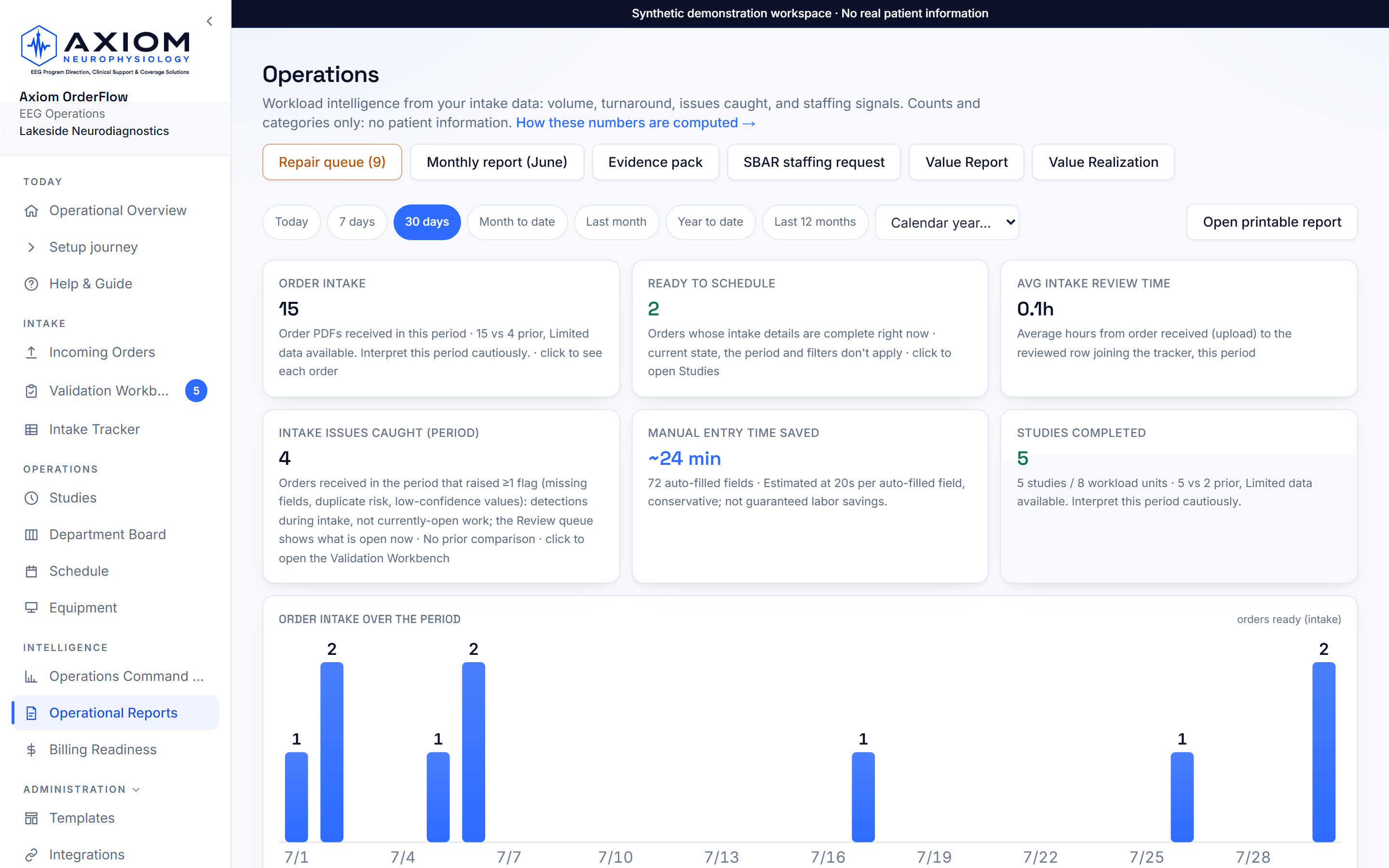
axiomorderflow.com/operations
Axiom OrderFlow Operations view for a single facility showing intake, timing, reader turnaround, and workload

Per-site Operations: intake, timing, reader turnaround, and workload for one facility. Captured from the live application on a synthetic demo workspace.

Interfaces and identity, scoped honestly.

Two areas get oversold in this market. Here is what is contracted, what is separate, and what is not built.

Interfaces

Axiom supports governed HL7 v2 and FHIR R4 interface workflows through a hospital's interface engine. Each production connection is separately scoped, tested, and accepted with the customer's interface team.

Identity

SAML identity setup requires a separate contracted scope. Automated SCIM provisioning remains roadmap and is not available in this release, so please do not plan a rollout around it.

A site can start before its interfaceSecure document upload, email, and configured fax intake are available without an interface project, so a facility can go live and add a governed interface later.
Interface operations, not just a connectionMessage monitoring, quarantine, replay, and reconciliation sit inside the contracted Enterprise interface scope, so a failed message is visible work rather than a silent gap.
Tenant isolation, continuously testedTenant-isolation controls are implemented at the database layer (PostgreSQL row-level security scoped to your organization on customer-data tables) and at the application layer, and are continuously tested against supported access paths, including cross-tenant reads and writes with leaked record identifiers.
Append-only audit historyApprovals, edits, deletions, and permission changes are written through audited paths, with the actor stamped from the server session rather than supplied by the client. Deletions are highlighted and the trail is append-only.
PHI readinessDemo workspaces are for synthetic data only, and that restriction is contractual and operational rather than technical. A database constraint pins the patient-identifying mode off, but it governs the mode flag, not the contents of a field: this release does not technically prevent someone typing patient information into an order, so please do not enter or upload real PHI. No PHI readiness is claimed until production security hardening, compliance review, signed Business Associate Agreements with our data and AI subprocessors, and facility approvals are complete.

Axiom Enterprise

The scope a health system contracts for.

Final scope is set in a statement of work after an operational assessment.

What is included, what is separate, what is not built

For multi-site hospitals, regional EEG programs, and health systems.

SubscriptionAxiom Enterprise, invoiced by agreement. No payment processor.
One-time implementationA separate engagement, scoped in a statement of work covering sites, interfaces, identity, migration, validation, and rollout.
FacilitiesMultiple facilities and campuses within contracted scope.
SupportContractual support and service-level options, with named customer-success ownership.
InterfacesHL7 v2 and FHIR R4 through your interface engine, within contracted scope, including monitoring, quarantine, replay, and reconciliation.
IdentitySAML identity setup requires a separate contracted scope.
ProvisioningAutomated SCIM provisioning remains roadmap. It is not part of this release.
GovernanceCross-site governance and analytics, organization-configurable SLAs and escalation policies, and finalized Evidence Packs with integrity verification.
Custom developmentBy approved statement of work only.

Integration, identity, multi-site control, and contractual service levels, scoped by statement of work.

Multi-site health systems

Start at one site. Prove it before the second.

A 30-minute EEG operations review across your facilities, then a paid, fixed-scope pilot on synthetic or de-identified data.

Or email info@axiomeeg.com

Multi-Site EEG Operations | Axiom OrderFlow | Axiom OrderFlow