The complete operations workflow for your EEG department.
Move orders from intake review through scheduling readiness, study operations, device accountability, reader follow-up, and leadership reporting, all in one governed workflow.
Do not include patient information in demo requests. Demo environments use synthetic data only.
Human-reviewed. Built specifically for EEG. Designed to complement your EHR and EEG acquisition system.
Intake
Upload, email, and configured fax arrivals wait in one validated queue.
Studies
Assignment, hookup, daily checks, disconnect, and completion, in order.
Devices
EEG carts and ambulatory devices with custody, cleaning, and inspection.
Evidence
Audited history, published handoffs, and reports leadership can read.
Reporting depth follows what your team records.
The department reality
None of this is unusual. It is what happens when the work outgrows the tools carrying it.
Every line below describes coordination the department already performs. The cost is that it lives in five places at once.
01Orders move through email, fax, spreadsheets, and verbal follow-upFour channels, four places to look, and no single queue that says what arrived today.
02Scheduling-readiness gaps surface at the bedside, not at intakeA missing study type or authorization becomes a problem once the patient is already waiting.
03Ambulatory devices and reading physicians are coordinated from memoryWho has which device, when it returns, and who is reading today, all held by one person.
04Operational blind spots between shifts and rolesThe oncoming crew inherits whatever the outgoing crew remembered to say out loud.
05Leadership reporting is assembled by hand every monthVolume, turnaround, and workload rebuilt from scratch, then defended from memory.
One record the whole department works from.
Five changes, in the order a department notices them.
The workflow is governed rather than automated. People still make the calls; the platform makes sure the call is recorded, visible, and attributable.
One department workflow with role-specific work surfaces: technologist runlist, supervisor board, department wall board
EEG cart and ambulatory-device checkout, return, and cleaning accountability
Reader follow-up and charge-status reconciliation stay visible until closed
Every change is audited; shift handoffs are published and acknowledged
Operational evidence organizes itself as your team works
Where today’s tools land
The same work your department already does, with one place to look.
Where it lives today
What that costs
In Axiom OrderFlow
A shared intake spreadsheet
Everyone edits it, nobody owns it
The Intake Tracker, with your columns and an audited history
The wall whiteboard
Current only while someone maintains it
The Department Board, refreshing itself every minute
Email and fax follow-up
An arrival is invisible until someone opens the inbox
One validation queue, with sender and arrival time recorded
Sticky notes on the cart
Custody depends on who remembers
Checkout, return, cleaning, and inspection against order numbers
A hand-built monthly report
Rebuilt from scratch, and hard to defend in a budget meeting
Operations reporting drawn from what your team already recorded
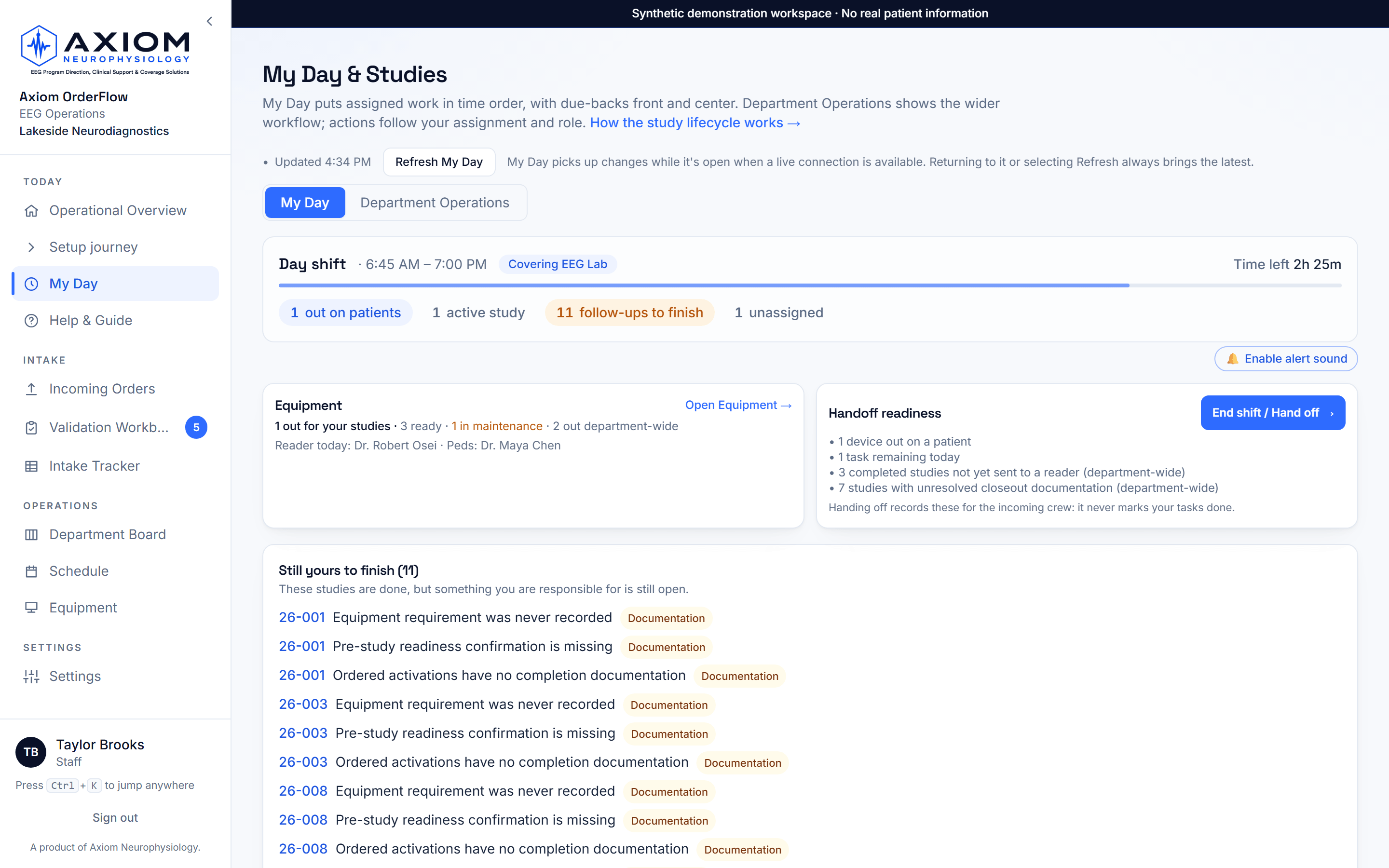
The technologist opens a runlist, not a spreadsheet.
My Day orders the shift by what is due next, and it knows an ambulatory study is two separate jobs.
Hookups sit at their scheduled times. The disconnect appears when the wear window actually ends.
Out on patients lists every device on a patient with its due-back countdown.
Admitted monitoring carries a daily check that records who logged it, and when.
Completing a study asks for the disconnect details once: device, cleaning, skin check, handoff note.
axiomorderflow.com/studies
axiomorderflow.com/studies
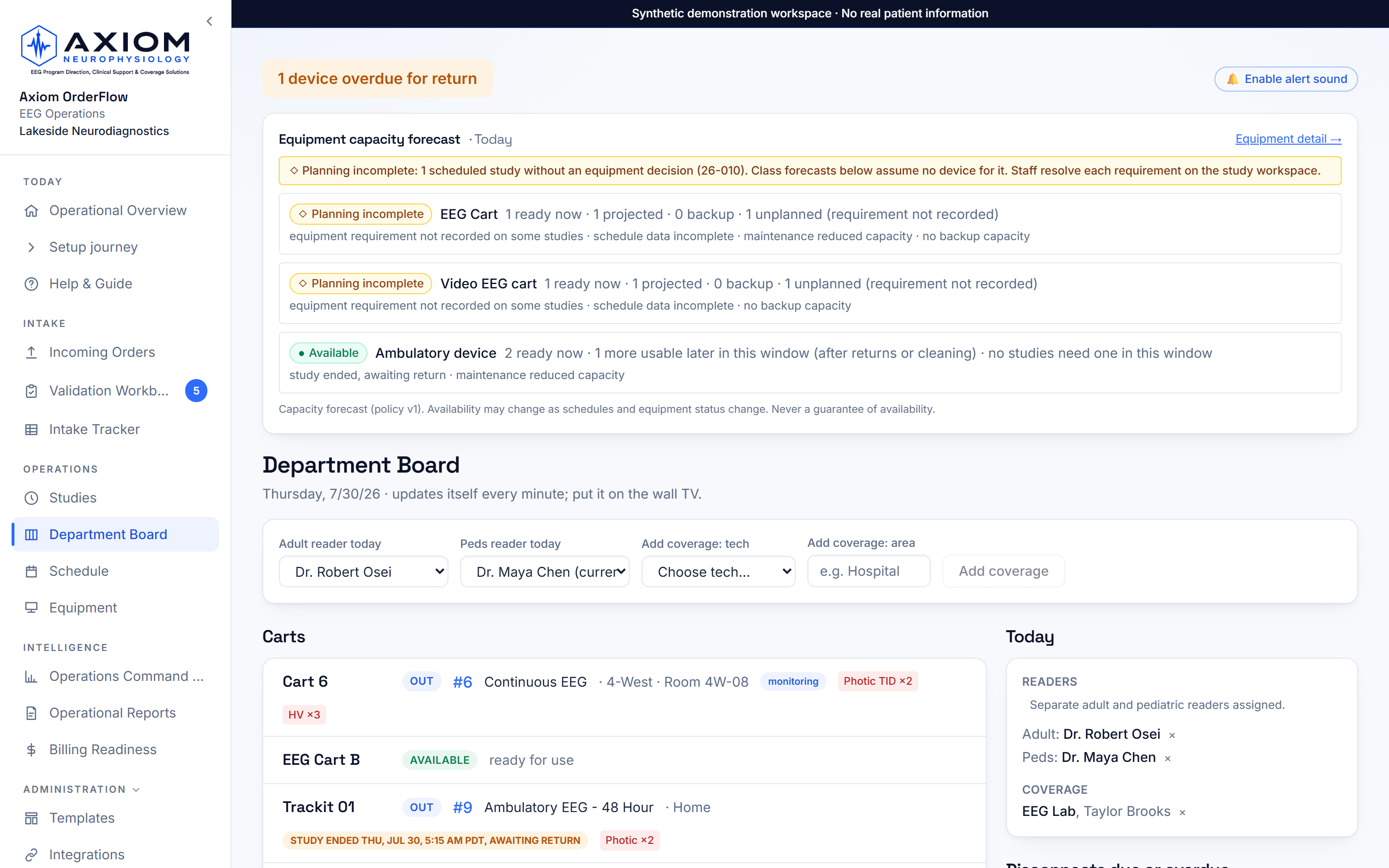
Put the board on the department TV.
Every cart joined to the study it is running, today’s disconnects, and the readers of the day. It refreshes itself every minute, so nobody maintains it.
axiomorderflow.com/board
Active now
Each running study with its room, elapsed time, accountable technologist, and linked device.
Due or overdue
Disconnects are split, so an overdue device is never mixed in with work still on schedule.
Readers of the day
Set the adult and pediatric reader once. Send-to-reader then arrives prefilled with the right one.
Devices are checked out against order numbers, never patient names. Study numbers and rooms come from your own template columns.
What a supervisor is actually chasing.
Four things that go wrong quietly. Each one has a surface that keeps it visible until it closes.
“Where is that device, and is it clean?”
Equipment custody
Checkout and return recorded against an order number
A return lands in the cleaning queue until someone attests to it
Inspection dates gate checkout, and a supervisor override is recorded with its reason
“Who has this study, and how long has it waited?”
Reader follow-up
Unread studies age in buckets: amber, then red, then escalate
Per-reader pending load, oldest wait, and turnaround
A read closes with a named signer, not a status guess
“What finished but never became a charge?”
Charge-status reconciliation
Charge-ready and unbilled work, oldest first
Work still waiting on interpretation is shown separately, not counted late
Figures use your own chargemaster rates: gross charges, never collections
“What does the next crew need to know?”
Shift handoff
Open work is frozen into a published record instead of retyped
A shift, a team, or a named person acknowledges it
The printout comes from the published record, so paper matches what was signed
Governance & boundaries
Audited by default, honest about the limits.
A department buyer needs to know exactly where the software stops. Each boundary below states what is implemented in the product and what is a contractual or operational commitment, so a reviewer can tell the two apart.
PHI readiness
Demo workspaces are for synthetic data only, and that restriction is contractual and operational rather than technical. A database constraint pins the patient-identifying mode off, but it governs the mode flag, not the contents of a field: this release does not technically prevent someone typing patient information into an order, so please do not enter or upload real PHI. No PHI readiness is claimed until production security hardening, compliance review, signed Business Associate Agreements with our data and AI subprocessors, and facility approvals are complete.
Human validation is structuralNothing reaches the Intake Tracker without a person reviewing it. The platform does not approve orders or make clinical decisions.
Append-only audit historyApprovals, edits, deletions, and permission changes are written through audited paths, with the actor stamped from the server session rather than supplied by the client. Deletions are highlighted, and original documents follow the workspace’s configured retention policy.
Role and tenant boundariesTenant-isolation controls are implemented at the database and application layers, and are continuously tested against supported access paths, including cross-tenant reads and writes with leaked record identifiers.
Interfaces are scoped, not assumedAxiom supports governed HL7 v2 and FHIR R4 interface workflows through a hospital's interface engine. Each production connection is separately scoped, tested, and accepted with the customer's interface team.
Money means gross chargesFinancial views use your own chargemaster rates. Never collections, never reimbursement, never a revenue guarantee.
Scoped for one department.
The department package carries the full operations workflow. What a proposal changes is scale, interface scope, and support depth.
Axiom Department
The complete departmental operations workflow, with priority support and a scoped department implementation.
Axiom Departmentplus a scoped one-time implementationUnlimited users within contracted scopePriority support
Not included in Axiom Department
Production interfaces and SSO (separately scoped add-ons)
Extensive historical migration
Multiple facilities, onsite training, or custom development
Invoice-based billing, no payment processor. Final pricing depends on locations, order volume, interfaces, identity configuration, migration, training, and support scope. The one-time implementation is scoped in a proposal after an operational assessment.
A controlled 90-day department pilot is available. Pilot fees credit toward implementation on conversion. Pilots are paid, fixed-scope software engagements, not free trials. A controlled pilot is the software engagement, separate from the Axiom Neurophysiology consulting pilot. See the full commercial model
Hospital EEG departments
Show us one week of your department. We will show you where it goes.
A 30-minute EEG operations review covering your intake channels, your study mix, your reader turnaround, and your device reality. No patient information, no obligation.