
An EEG operations layer designed to complement Epic, not replace it.
Axiom OrderFlow supports the specialized operational work between EEG order arrival, scheduling readiness, study execution, equipment, reader follow-up, and reporting while Epic or another EHR remains the clinical system of record.
Direct answer
Axiom OrderFlow is not an Epic module and does not claim an active Epic integration by default.
It is a specialized EEG operations platform that can work beside an EHR through approved document workflows and, when separately scoped, governed HL7 v2 or FHIR R4 interfaces through the hospital's interface engine.
The order lives in the EHR. The workflow does not.
Six gaps EEG leaders and interface teams name when they map what the enterprise record covers and what it leaves to the department.
Order, not operations
The EHR contains the clinical order but not the department's full operating workflow.
Readiness in a side file
EEG-specific readiness and follow-up live in side spreadsheets.
Devices and reads out of view
Device return, cleaning, and reader aging are outside the primary order view.
Reporting without touching the chart
A department needs specialized reporting without changing the clinical record.
Claims ahead of acceptance
Interface claims are made before mapping, testing, and acceptance occur.
No stated fallback
Manual fallback is unclear when an interface is unavailable.
Readiness is not the same as a live connection.
Axiom supports governed HL7 v2 and FHIR R4 interface workflows through a hospital’s interface engine. Each production connection is separately scoped, tested, and accepted with the customer’s interface team.
What runs on day one, and what a contracted interface adds
Including what is not available until your interface team has accepted it.
| Capability | Without an interface project | With a contracted interface |
|---|---|---|
| Intake channels | ||
| Secure document upload | Included | Included |
| Inbound email intake | Included | Included |
| Fax intake | Included | Included |
| Manual entry and correction | Included | Included |
| Interface workflows | ||
| HL7 v2 order message workflows | Synthetic and test messages only | Accepted production scope |
| FHIR R4 order message workflows | Synthetic and test messages only | Accepted production scope |
| Production connection to a specific Epic or EHR environment | — | Contracted, implemented, tested, accepted |
| Message quarantine, replay, and reconciliation | — | Included in contracted scope |
| Continuity | ||
| Human review before an order becomes work | Required | Required |
| Governed document and manual fallback | Included | Remains available |
Channels, interfaces, and monitoring depend on package, workspace configuration, and contracted scope. A production connection is established during implementation, never assumed at signature.
Six commitments your interface team can hold us to.
Each one is a boundary as much as a feature, written so a security or interface reviewer can check it against the product.
Complementary operating layer
Keep Epic or another EHR as the clinical authority while OrderFlow organizes EEG-specific intake and operations.
Governed interface scope
Each production connection is separately defined with message type, mapping, source authority, error handling, testing, and acceptance.
Scope is written down before activation, so a reviewer can tell a capability from a commitment.
HL7 v2 and FHIR R4 readiness
The platform supports governed interface workflows through a hospital's interface engine; readiness is not the same as a live connection.
Human-reviewed intake
Mapped or extracted information remains subject to the approved review and workflow rules for the configured use case.
Quarantine and replay
Invalid or failed interface messages can be held for controlled review rather than silently becoming accepted workflow state.
Auditable fallback
Manual or document-based intake can remain available under governed procedures when an interface is not in service.
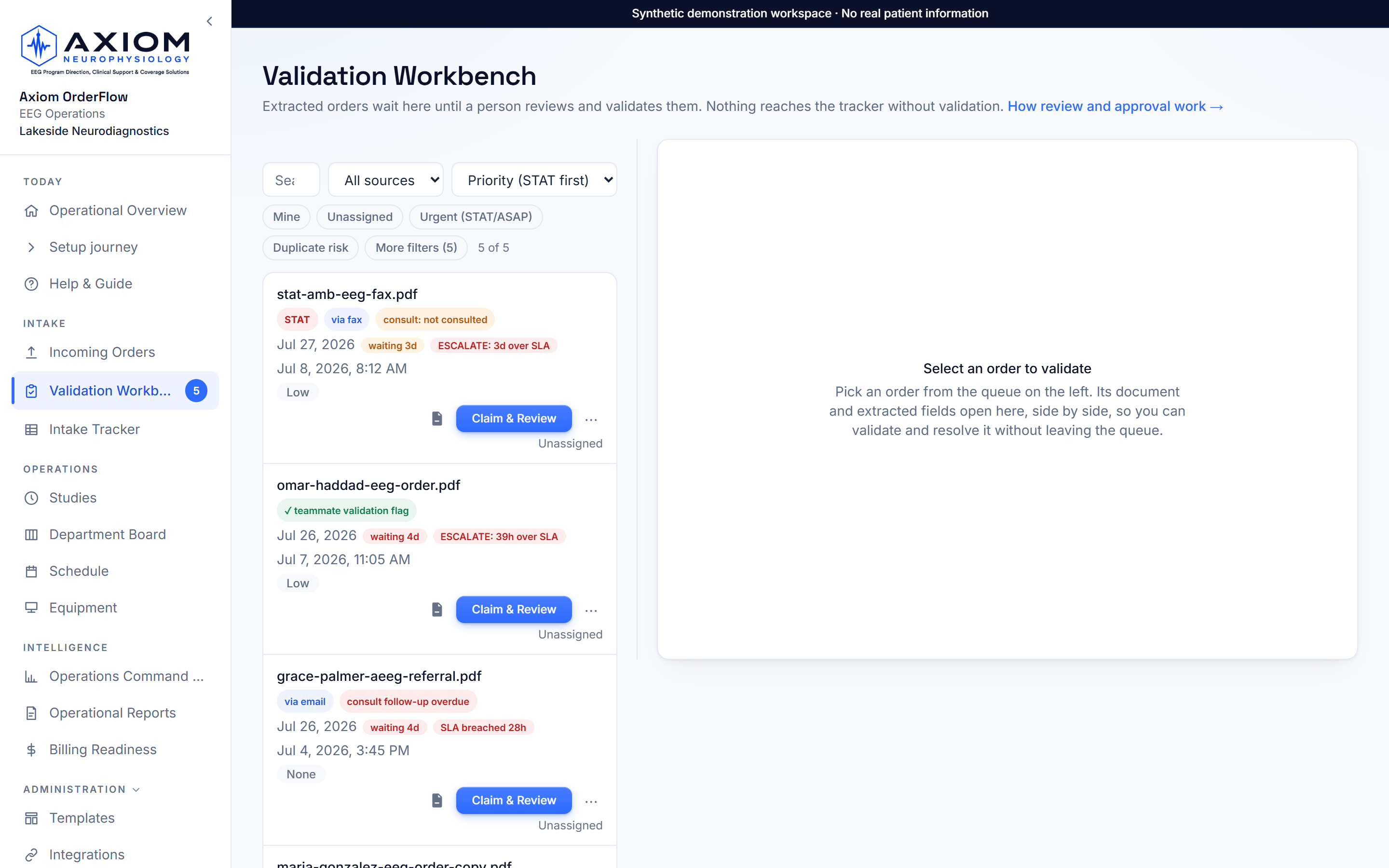
However the order arrives, a person validates it.
Interface message, emailed PDF, fax, or manual entry. The review step in front of the tracker does not change.
- Mapped or extracted details are proposed to a reviewer, never written straight through as accepted workflow state.
- Missing information, duplicate risk, priority, and aging surface before anything is scheduled.
- Invalid or failed interface messages are held for controlled review, then replayed once the cause is fixed.
- If an interface is out of service, governed document and manual intake keep the department running.
Captured from the live application on a synthetic demo workspace. No patient information appears in any image.
How a production interface actually gets turned on.
Six steps, in order. None of them happens on our side alone, and none of them is skipped to make a demo look better.
Who this page is written for
This page is for EEG leaders, hospital IT, interface teams, and security reviewers evaluating where a specialized workflow platform can add value without displacing Epic or another enterprise EHR.
- Define the sources of authorityThe hospital and Axiom define the EHR, interface engine, OrderFlow, and human sources of authority.
- Map fields and failure behaviorRequired fields, codes, identifiers, events, and failure behavior are mapped.
- Validate off productionSynthetic and approved test messages are validated in a non-production environment.
- Complete the approvalsSecurity, contractual, operational, and facility approvals are completed.
- Activate to the accepted scopeThe interface is activated only for the accepted scope and monitored for failures.
- Govern every change afterChanges, replay, fallback, and deactivation follow governed procedures.
What it does not replace.
Precision here is the product. A reviewer should be able to tell a shipped capability from a contractual commitment without asking us.
Out of scope, on purpose
- The EHR. Epic and facility-governed clinical systems retain their authority as the clinical system of record.
- Facility policy, medical director oversight, and neurologist interpretation.
- The EEG acquisition system. OrderFlow does not acquire, display, or interpret EEG signals.
- Clinical decisions. It coordinates operational work and evidence around EEG orders and studies.
- The facility scheduling system of record, where one is in place.
Trademark and claim boundary
Axiom is not claiming Epic partnership, certification, native integration, or an active connection unless a specific customer interface has been contracted, implemented, tested, and accepted. Epic is a trademark of its owner; references here identify compatibility context only.
Questions interface teams ask first.
Is Axiom OrderFlow an Epic product?
No. Axiom OrderFlow is an independent product of Axiom Neurophysiology.
Is it already integrated with every Epic environment?
No. Every production connection is separately scoped, mapped, tested, approved, and accepted with the customer's interface team.
Can it work without an interface?
Yes. Approved PDF upload, inbound document workflows, and manual intake can support a controlled implementation depending on package and configuration.
Does OrderFlow become the clinical system of record?
No. The EHR and facility-governed clinical systems retain their authority. OrderFlow supports specialized EEG intake and operations.
Bring your interface team to the first call.
We will walk the intake channels you can run today, the scope a governed interface needs, and the fallback that works either way.
Or email info@axiomeeg.com
Do not include patient information in demo requests. Demo environments use synthetic data only.